Board Game Prototype:
This week I dabbled in designing a board game. In order to get better at complex games in any medium, designers have to start with the basic board game. In doing so, you learn your target audience, how well rules are clarified and whether or not your initial idea is even any fun.
The Game:
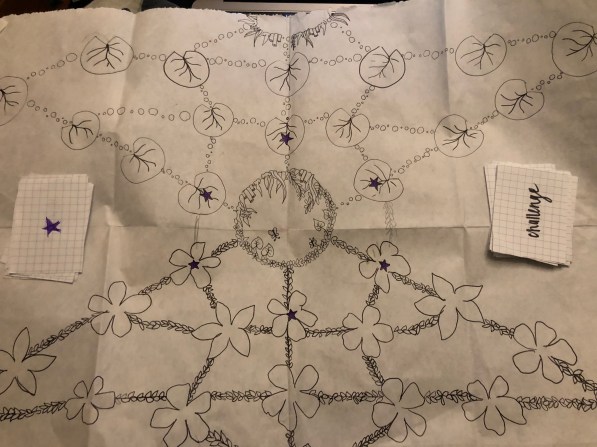
The game I came up with has a mashup of elements from other board games I’ve played in the past. There are a few elements reminiscent of chess, backgammon and draw cards similar to those in monopoly.
Game Rules :
- Highest roll goes first.
- Each Player gets 3 defenders and 1 Player piece
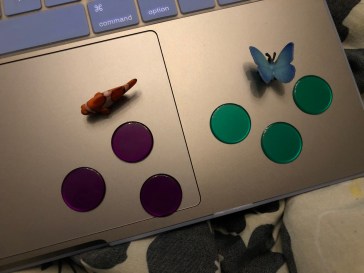
- Defenders and Player piece both begin in goals
- 3 ways to win:
- Player piece gets to opposing goal
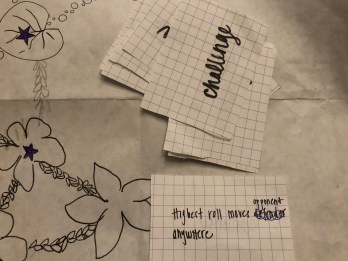
- A challenge card is drawn and one of the players loses their player piece in the challenge.
- If a player loses all defenders, they lose the game.
- Player pieces (butterfly or fish) can only move one space at a time.
- If you move your player piece, you do not get to roll dice for that turn.
- If opposing defenders land on the same spot, challenge card must be drawn.
- Defenders move in correspondence with dice roll.
- If a player piece makes it to the challenge arena they can steal one defender from opponent and add to their fleet.
- Defenders can only enter Challenge area if star card permits.

- Players cannot bypass star spaces to enter arena. If player opts to split dice roll between defenders, defender must stop at star space and remaining dice roll spaces must be moved by another defender.
- If two defenders land on star spaces in one turn, two separate star cards must be pulled.
- If defender gets inside challenge area and has lost a defender, they can earn a defender back.
- Dice roll number can be split between defenders.
Mechanics:
Roll/Spin and Move
Card Drafting
Dice Rolling
Grid Movement
Variable Player Powers
Trading
Play Sessions:
Initial game:
The initial design of the game came about after bouncing ideas off my game design partner, Jerry. A large majority of time was spent deciding the games premise and how players could win. We collectively decided that it was important to include strategy as a mechanic of the game. We also wanted to add other elements that could either elongate or shorten the duration of the game. We started out with about 6 initial rules, assuming the basis of the game was clear enough. We quickly realized that we might have been completely wrong. After running through the game quickly, the most obvious changes necessary were; the need for more challenge cards (both in number and variety) and the need for more landing path spaces. The game ended relatively quickly as most of our time was spent on brainstorming and layout, which didn’t leave us with much time to indulge in actual game play. It’s also important to note that at the time, I assumed that the game session went smoothly, when in reality, it was most likely because of the fact that I played it with the only other person who helped design it. I say that to say, it was easy to play the game without a complete and clear set of rules because as the designers, we both knew how we intended the game to be played.
Second game:
I played the game a second time with a friend who was completely oblivious to the rules and premise of the game going in. After adding the elements that I initially thought were missing, and clarifying a couple of the rules, I explained the game to my new opponent. In all honestly, he looked a little wary of my explanation. But we all know, practice makes perfect, so the game commenced. It was in this game session that I learned the most as the game designer. Since I wasn’t playing with Jerry, it was completely up to me to explain the rules and “what-if’s.” Needless to say, as the game carried on I had to clarify rules even further and add about 5 more rules for situations that arose in this second game that weren’t present in the first. These rules included:
– Who was allowed in the center challenge arena
– How many pieces could be on one space at the same time
– How to earn a defender back
– Being unable to bypass star spaces
As we continued to play and rules continued to clarify and multiply, the game began to run more smoothly. The game lasted about 20-25 minutes and I ended up losing at my own game on a challenge card. Throughout the duration of the game I paid close attention to my friend’s reactions. It was exciting and fulfilling as the game designer to see him strategizing and ultimately gloat in my face as he won. Although I lost, seeing him react to my prototype in the same and/or similar way that he would to a game on the market was a win.
Third Game:
The third game was played with another game designer Alani. Like my friend, she too had no idea of the rules or premise of the game going in. This session also pinpointed rules that needed clarification and/or stating in the first place. This session was also a learning experience being that I was playing with a fellow game designer. Her questions and suggestions were coming from a fresh set of game designing eyes that allowed me to further clarify rules and questions for whomever may play in the future. During this game session, we decided that some specific draw cards should be clarified and/or pulled. Those that were to be pulled were done so because they were either too vague or confusing for players who didn’t have a hand in designing the game. (Going back to the point from the first game session with Jerry in not taking into consideration that I had a biased knowledge of how the game should be played because I designed it) We decided that if I wasn’t playing the game, two new players wouldn’t be able to easily decipher how to go about certain draw cards.
After this final game, I have a more clear understanding of some tweaks to be made. It’s definitely easy to get caught up trying to make the most fun board game from the gate rather than a simple game that can be built upon to make more fun/ challenging. There are still some aspects to be clarified, eliminated and added to make this game run smoothly. The idea is there, so back to the drawing board!
 Jasmine Zamora